As Cannes Lions 2015 begins, my thoughts on some other needed awards for creativity in advertising. To read, please visit my new website at http://jdavidslocum.com .
Showing posts with label advertising. Show all posts
Showing posts with label advertising. Show all posts
Saturday, June 20, 2015


Saturday, September 13, 2014
Dave Trott and the Challenge of Creative Thinking (While Still Learning)
Dave Trott is a British advertising legend. He’s written two books and keeps a lively and
provocative blog. He also regularly
speaks to industry audiences, including a talk to EMBA participants at
the Berlin School of Creative Leadership I was privileged to hear. I am a regular reader and admirer of his
work.
Trott’s writings tend to be anecdotal and provocative. He doesn’t offer recommendation lists or
how-to guides for doing better creative work or building creative organizations,
preferring to share observations, stories and occasional advice on generating
original work in an increasingly fraught brand marketing landscape. A recurrent priority is celebrating the
creative muse while also defending it against the ever-growing onslaught of
business demands, formulaic processes, and formal education.
His August 12 blogpost on ‘How “Learnings” Prevents Thinking’ captured
this priority nicely. As the title
conveys, the post discusses how learning can impede and constrain creative
thinking. In particular, Trott discusses
learning a ‘terminology’, that is, a set of terms that serve as agreed-upon ‘metaphors’
or shorthand for different activities.
The problem with such learning for him is that once learned, the meaning
of the terms can become ‘impenetrable’ and ‘accepted as fact’. Learnings here lead to the adoption of terms
and meanings that ‘no one ever questions’.
The result is that the questioning so fundamental to original thinking
is foreclosed.
As an educator, I found myself both agreeing with Trott’s
pragmatic argument but also being professionally unsettled by it. After all, I’ve spent years striving to
impart or, at least, enable creatives and other leaders to achieve learning in
the belief that it will improve them and their creative work. Pausing over the blogpost, and returning to
his two books, Creative Mischief (2011) and Predatory Thinking: A Masterclass in Out-Thinking the Competition (2013), I asked
myself whether the education or training or ‘formal’ inputs I provide were
possibly hindering the thinking of my creatives and executives.
Trott’s provocation is hardly the first of its kind, of
course. Others have rightly questioned
the influence, often negative, of educational processes and systems on
creativity and imagination. Perhaps most
familiarly, and cogently, Sir Ken Robinson has called for reforms in education and training to
unleash and encourage rather than repress and inhibit imagination and creative
thinking.
While Robinson’s primary focus has been on the schooling of
children, his broader insights have great relevance to adults and,
particularly, their organizations, like the corporation. The systems, specializations, and processes
that shape and define businesses and many other organizations appear to constrain
original thinking and creativity in ways similar to rote learning and
memorization in schools. Longstanding has been the perceived discrepancy
between the imperatives of business efficiency, productivity, and the bottom
line and the possibilities of more open-ended innovation, risk-taking, and
creative thinking.
Recently, however, more and more businesses have begun to
recognize that some systems or processes can be necessary and even contribute positively
to creative thinking and original outputs.
Adaptable and human-centered approaches, like agile or design thinking,
for example, seem to support both organizational and individual needs for sustained performance and growth. Such processes
form less a discordant constraint than a productive tension enabling people to
reflect and question as a basis of their own creative work and contribution to
a larger, collective endeavor.
In the words of Trott’s post, the processes allow
individuals precisely to question the terminology they use together. It is worth observing that many of the terms
he mentions are trendy and deserve not only to be questioned but potentially cast aside
entirely for overuse. The list is
(sadly) long: ‘Brand audit, cluster groups, segmentation, penetration, CRM,
SEO, CSR, ROI, KPI, UGC, integrated, transactional, native-advertising,
value-added, differentials, core-competency, ideation, hygiene-factors,
demographics, psychographics, profile-testing, deliverables, storytelling,
narrow-casting, acquisition, content, data-capture, rate card, deep-dive’.
In my own work with creatives and other leaders, a core
belief is indeed to question the basic terms of business whose deeper and more
complex meanings are discussed too infrequently in individual settings,
situations, and contexts. Among these are talent,
business model, strategy, culture, technology, operations, and finance. Particularly at a time when being successful
creatively often means having the capabilities to generate creative business
solutions for clients and customers, such fundamental terms should not only be
engaged but interrogated as a source of potential advantage.
So perhaps, as an educator, I stand closer to Dave Trott
than I had initially imagined upon reading his post. Rather than simply assigning or parroting
fixed meanings, the ‘learning’ we should strive for is open-ended, adaptive, and committed to
the ongoing interrogation of ‘terminology’ and the possibilities of any
situation. That process also seems a
promising one to encourage more consistently unconstrained creative thinking in
business and beyond.
Friday, June 20, 2014
Building New Strategies for Creative Excellence: Michael Porter vs. Chuck Porter
On Thursday evening, June 19, I had the privilege of
presenting ideas for 'building new strategies for creative excellence' at the Cannes
Lions International Festival of Creativity. The session grew out of a
White Paper with the same title co-authored with my Berlin School of Creative
Leadership colleague, Professor Paul Verdin. Guiding both session and paper were a series of contrasts drawn between the strategic thinking of Harvard Professor Michael Porter and the strategy Paul and I identified in the words and work of advertising legend Chuck Porter. (The full paper is
downloadable here.)
The Executive Summary reads:
Strategy is changing amidst volatile markets, disruptive
technologies, and transformed customer and public relationships. Contrasting
some of the major tenets of traditional strategic thinking, an analysis of the
work and words of Chuck Porter enables the mapping of several key principles of
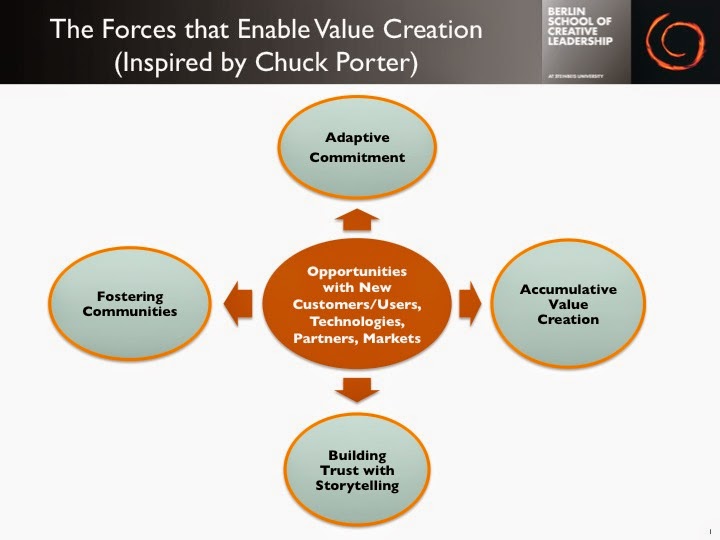
a new strategy of creative excellence. These include 1) forming an
adaptive commitment to strategic intent and ongoing public engagement, 2)
fostering communities of participation as part of generating a wider cultural
conversation of creative work, 3) building trust through imaginative, often
offbeat and interactive storytelling, and 4) moving beyond competition to
highlight the value emerging through creative breakthroughs or
community-building.
The following images give a further sense of the contrast we draw between the 'Five Forces' model of industry competition that shape firm strategy of Michael Porter and the emergent Forces that enable value creation we associate with Chuck Porter.

Subscribe to:
Posts (Atom)