Showing posts with label leadership. Show all posts

Wednesday, November 19, 2014

Vulgar Creativity

“Companies constantly tell us about their commitment to excellence, implying that this means they will make only top-shelf products. Words like quality and excellence are misapplied so relentlessly that they border on meaningless….To ensure quality, then, excellence must be an earned word, attributed by others to us, not proclaimed by us about ourselves.”
                                                --Ed Catmull (with Amy Wallace) in Creativity, Inc.


Catmull and Wallace’s recent account of Pixar’s decades-long journey is an impassioned call for individuals and organizations not just to speak their core beliefs and values but to act on them consistently and imaginatively.  Many of these beliefs, from quality and excellence to “trust the process” and “story is king” are familiar invocations of business intent and purpose.  Yet running through Creativity, Inc. is the crucial insight that repeating such words and phrases can actually provide false confidence and be counter-productive if they ring hollow and are not put into practice.   

Probably the word with the most potential to mislead is “creativity” itself and Catmull and Wallace’s book can be read as a 368-page illustration of how an ongoing, collective, and enacted focus can make the commitment to that value real and dynamic.  At a time when “creativity” and “innovation” appear everywhere in corporate pronouncements, doing more than parroting the words is a consistent challenge for leaders and organizations.  I have written about this elsewhere, as have others, like Shane Snow, who goes so far as assert, “If you have tocall yourself innovative, you’re probably not.” 

Beyond taking care with one’s own usage of these basic terms, a question arises about the recognition by others of a given individual’s or firm’s creativity or innovation.  These are enormously slippery concepts, varying across cultures and industries and markets.  The novelty, freshness or utility celebrated in one situation or context can be viewed as familiar or even clichéd in another.  As a result, we might reasonably ask, How can creativity become an “earned word, attributed by others to us”?

One answer is to consider what I call “vulgar creativity” in assessing and practicing imaginative activities and production.  The qualifying word, “vulgar,” has several meanings and historical resonances that are vital to approaching that process.  While not one-dimensional, the term can nevertheless help to orient our thinking and actions around creativity in businesses and elsewhere. 

“Vulgar” derives from the Latin word for “common people” and originally was used to describe their ordinary, everyday uses of things or ideas.  A “vulgar tongue” in the Middle Ages thus meant the actual or vernacular language of a people as opposed to an official or elite one.  Over the last century, sophisticated social and cultural theorists from Walter Benjamin to Terry Eagleton have criticized “vulgar Marxism” for reductionist readings of Marx and Engels that claim ideology (including art and creative work) is simply determined by economic structures.  There’s irony, for some, in such bemoaning of a common people’s understanding of Marx, who, after all, sought to empower them.  More importantly, though, the example casts in relief two distinct (if often overlapping) meanings conveyed by the term, vulgar – namely, of being of the people and ordinary and of oversimplification, edginess, and even crudeness.   

That everyone is, or has the potential to be, (more) creative has become an article of faith for many in the twenty-first century.  Sir Ken Robinson is a persuasive and much-admired exponent of this view.  He concentrates on how schools “kill creativity” in order to illuminate alternative ways that they, and other organizations including businesses, can cultivate and liberate individual imagination.  By helping unlearn the standardized “command and control” approaches to learning that predominate in education, he calls instead for a diverse, individualized and organic approach to encouraging students to thrive.  Rather than a select, chosen creative few, Robinson’s presumption is that these changes will foster the curiosity and unleash the ability to experiment existing in us all.

It is here, however, that the second meaning of vulgar can re-emerge and complicate our celebration of universal creativity.  Conventionally, creative activity involves plunging into the unknown, engaging unorthodox thinking, experimenting continuously, and incorporating a bit of irreverence (to use advertising legend Sir John Hegarty’s term).  Yet those drives, particularly in business, are often reduced to simplistic taglines or formulaic processes.  Even worse, the admirable goal of nurturing greater creativity too often turns merely on unfettering individual free thinking or expression.  Supporting creativity, in other words, becomes about removing as many filters, structures or other constraints as possible rather than building a diverse, stimulating, and organic environment that cultivates individual and group learning and imagination.     

Simply unfiltering individual expression or behavior may have individual value in terms of personal fulfillment or happiness (or other indirect benefits to organizations or groups), but it does not necessarily provide the makings of a wider and more sustainable creative culture.  The British scholar of creativity, Margaret Boden, once distinguished personal from historical creativity by observing that what is novel to one individual at any given moment is often not to the wider society or across history.  While that personal creative expressiveness should be nurtured, it also needs to be differentiated from what is new, surprising or useful for larger communities, markets or societies. 

To be mindful of vulgar creativity is to recognize both the ordinary, democratic potential of creativity and, in business, particularly, its social or organizational reality and dynamics.  The point is not to judge worthy those efforts at fostering creativity affirmed by crowds or markets and dismiss others.  However, it is to acknowledge that, too often in business, attention to creativity and innovation is reduced to celebrating novelty without value or facilitating individual expression without wider purpose.

In 1982, film and cultural commentator J. Hoberman published “Vulgar Modernism,” an article in which he argued that many popular, even apparently tasteless productions like Dean Martin and Jerry Lewis comedies, Tex Avery cartoons and Mad magazine, engaged some of the same mid-twentieth century aesthetic, institutional and social questions as the Modernist art of Picasso, Manet, and bebop.  Hoberman was seeking to make sense of the post-World War II years in which a fraught relationship between popular and “high” cultures was being renegotiated.  Invoking the “vulgar” became a way to approach the rich and productive tensions marking the practices of mainstream media and audiences.

Only a few years later, pioneering adman Bill Bernbach observed, “Is creativity some obscure, esoteric art form? Not on your life. It’s the most practical thing a businessman can employ.”  For Bernbach then, and continuing in business today, the successful approach to creativity should be similarly broad and shaped by productive tensions – between espoused beliefs and substantive actions, customer needs and firm purpose, and organizational processes and individual imagination.  In its embrace of such crucial tensions, “vulgar creativity” can provide another reminder to leaders of the value of empowering more universal creativity while always grounding that effort in the world they see and aspire to change.     

Friday, August 22, 2014

'The Alliance: Managing Talent in the Networked Age,' by Reid Hoffman, Ben Casnocha, Chris Yeh (Harvard Business Review Press, 2014)

The implied social contract that has long existed between larger companies and their workers is evolving.  Often described (by company leaders, at least) as like that of ‘families’, the relationship between individual employees and firms has typically been defined in terms of short-term performance and behavioral targets and the rewards or sanctions that can result.  In many places, this relationship has become increasingly one-sided, with mounting obligations of service and performance for individual employees but few corresponding obligations besides financial compensation to the employee by the firm. 

Recognizing that lack of reciprocity and mutual benefit in the relationship between employees and firms, many leaders are increasingly developing innovative workplace policies and practices.  Some of these involve radical restructuring of corporations themselves, as Tony Hsieh has pursued at Zappo’s by shifting authority from hierarchy to ‘holacracy’, a fractal and democratic governance system focused on a specific purpose (like customer service).  Others have similarly rethought the central activity of organizational decision-making, like at Dark Horse, the Berlin-based design firm, where ‘sociocracy’, or so-called circular organizing among equals, relies on consent rather than autocrat governance.  More generally, as Richard Sheridan captures in Joy, Inc. (Portfolio 2013), his inspiring account of Menlo Innovations, the imperative for many leaders today is to instill more flexibility and agility in their management of talent as a way to foster a happier and (hence) more productive workplace.

As these examples suggest, many current and prominent attempts are at newer and smaller businesses, where experimentation and thoroughgoing change are perceived to be easier to implement.  In The Alliance, the new book written by LinkedIn Chairman and co-founder Reid Hoffman, Ben Cosnacha and Chris Yeh, the guiding argument is that talent development and management need to be reconsidered and recast across businesses of all sizes and ages and in all industries and sectors.  The familiar macro-level drivers of such reworking include sweeping changes in the economy, blurring of industry boundaries, and transformations of talent markets.  Yet what is more compelling in the call of Hoffman and his co-authors is their practical and hands-on approach to engaging and empowering employees in order to enable mutual value creation benefitting both individual talents and the firm.

At the heart of the book is the idea of a ‘tour of duty’ for individual employees.  Hoffman recounts using this approach at LinkedIn to get beyond conventional talk about loyalty or commitment and instead to agree upon specific terms with employees for deals lasting two to four years.  The LinkedIn tours replaced open-ended arrangements that might have included fixed-term contracts but did not acknowledge the rhythms of growth and development experienced by both employee and company.  These more traditional arrangements also tended to leave vague or unspoken the expectations of both sides about the future and, especially, the possibility of continuing association.  Crucially, tours of duty recognize that after a given tour, individual employees often better serve themselves and the company by going elsewhere.  Rather than being a source of insecurity or instability, the transparent and shared understanding of what individual and firm can expect from each other, and for how long, powerfully engenders trust and encourages greater productivity and well-being.

No one model or approach fits all talent situations or organizations, of course, and one of the strengths of the book is that the ‘tour of duty’ model is both itself flexible and one of several options for shoring up and enhancing relationships between individual employees and businesses.  Recognizing that ‘stars’ are different from other employees or that age and industry variations may warrant different treatment, for example, may be intuitively obvious but are also often difficult steps for leaders to implement when dealing with real people.  Both in the main text and in several concretely helpful appendices, which offer sample statements of alliance as well as exercises on how to ensure alignment of individual and organizational expectations and goals, Hoffman and his co-authors illuminate the practical steps that leaders can take to design, launch and sustain successful talent management alliances.

What finally distinguishes The Alliance, however, is its attention to the broader contexts of the networked age indicated in the subtitle.  However provocative and practically useful to individual leaders and employees in dealing with each other more openly and reciprocally, the book recognizes how far-reaching is the potential of optimizing internal company as well as external networks for growth.  Put differently, while the alliance between individual talent and company may be a productive breakthrough for both, even more consequential are the individual and industry networks that today enable unprecedented connections between people, ideas and opportunities.  These connections provide the basis for individuals and companies to invest in each other and develop mutually defined and beneficial relationships.  Thanks to the excellent work of Hoffman, Casnocha and Yeh, we now have a clear, insightful and practically-oriented guide to building new and network-supported alliances with talent that have the potential to transform our leadership, our employees, and our businesses.

Friday, July 4, 2014

Review of 'Collective Genius: The Art and Practice of Leading Innovation,' by Linda A. Hill, Greg Brandeau, Emily Truelove & Kent Lineback (Boston: Harvard Business Review Press, 2014)

The Introduction to Collective Genius: The Art and Practice of Leading Innovation calls for a different kind of leader who creates organizations both willing and able to innovate.  From that innocuous opening, this new study quickly moves to engage the challenges and complexities confronting those wanting to enable innovation.  Much of the complexity is captured in six paradoxes – from “support” and “confrontation” to “bottom up” and “top down” – that create ongoing tension.  These are then summarized in a “fundamental paradox” between “unleashing” and “harnessing” the talents in an organization.  Through the dozen case studies that follow, these paradoxes demonstrate not only the potential of different kinds of leaders but the value of different kinds of thinking about leadership in fostering and driving innovation.

In less capable hands, such a reliance on paradoxes or tensions in describing leadership might reflect indecisive or incomplete analysis.  For Linda A. Hill, Greg Brandeau, Emily Truelove, and Kent Lineback, it instead conveys with evidence and assurance the complicated realities of new organizational forms and behaviors.  In fact, despite its presentation of a series of individual leaders, the book establishes a category of its own that yokes together the best of conventional analyses of leadership and innovation.  The result is an invaluable guide to enabling collaboration and collective behavior at a time when innovation and creative problem-solving are increasingly the norm.

The first major section of Collective Genius addresses how leaders create a willingness to do the hard work of innovation.  There are three major challenges here:
  • Purpose: Why we exist
  • Shared Values: What we agree is important
  • Rules of Engagement: How we interact with each other and think about problems
Defining these elements helps to create a context in which others can innovate.  Looking at Volkswagen and Pentagram, the design agency, the authors offer practical instances of encouraging risk-taking, trying new ideas, and building solutions together to form a greater sense of community.

The second major section takes on how leaders can create the ability to do the hard work of innovation.  It is also defined in three aspects: 
  • Creative Abrasion: The ability to generate ideas through discourse and debate
  • Creative Agility: The ability to test and experiment through quick pursuit, reflection and adjustment
  • Creative Resolution: The ability to make integrative decisions that combine disparate or even opposing ideas
Together, these organizational skills correspond to the major elements of the innovation process – collaboration, decision-based learning, and integrative decision-making.  Tracking efforts at Pixar, eBay in Germany, and Google, the authors offer examples of how practically these skills can be operationalized and also integrated with each other.  

Amidst all the discussion of innovation processes and organizational behavior, how exactly do leaders fit here?  They may be visionaries – but don’t have to be.  Even if they are, they don’t hold forth and inspire from the mountaintop.  Instead, the role of the leader is re-cast again and again in these pages.  Vineet Nayer, of HCL, is a “social architect”; Larry Smarr of Calit2, “a dot-connector extraordinaire”; and managers at Google, according to then CEO Eric Schmidt, “aggregators of viewpoints, not dictators of decisions.”  What is consistent in Collective Genius is that traditional formal authority gives way to nimble orchestration, informal facilitation, and contributions to community-building.

The real hero for Hill and her co-authors, as a result, is less the individual than the innovation eco-system.  Successful leaders, they conclude, work to create innovation environments “in which the unique slices of genius in their organization are rendered into a single work of collective genius.” Moreover, and this is ultimately the book's most illuminating lesson, that collective genius not only yields more sustainable innovation but transforms leadership itself. 

Friday, June 20, 2014

Building New Strategies for Creative Excellence: Michael Porter vs. Chuck Porter

On Thursday evening, June 19, I had the privilege of presenting ideas for 'building new strategies for creative excellence' at the Cannes Lions International Festival of Creativity.  The session grew out of a White Paper with the same title co-authored with my Berlin School of Creative Leadership colleague, Professor Paul Verdin.  Guiding both session and paper were a series of contrasts drawn between the strategic thinking of Harvard Professor Michael Porter and the strategy Paul and I identified in the words and work of advertising legend Chuck Porter.  (The full paper is downloadable here.)

The Executive Summary reads:
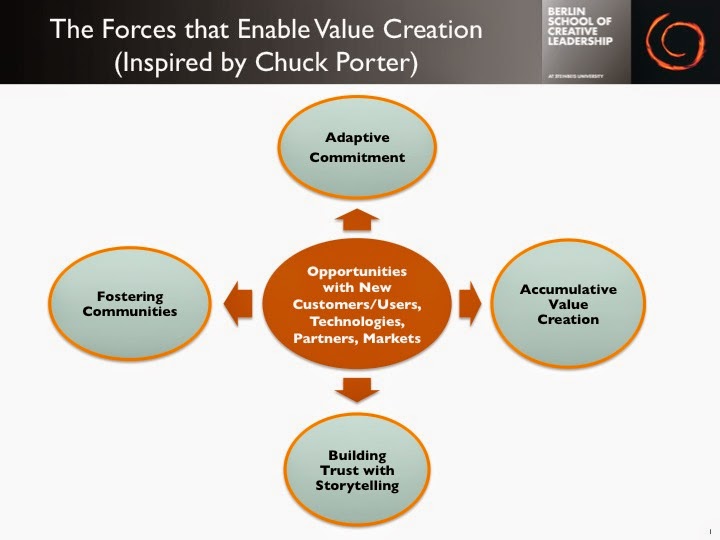
Strategy is changing amidst volatile markets, disruptive technologies, and transformed customer and public relationships. Contrasting some of the major tenets of traditional strategic thinking, an analysis of the work and words of Chuck Porter enables the mapping of several key principles of a new strategy of creative excellence.  These include 1) forming an adaptive commitment to strategic intent and ongoing public engagement, 2) fostering communities of participation as part of generating a wider cultural conversation of creative work, 3) building trust through imaginative, often offbeat and interactive storytelling, and 4) moving beyond competition to highlight the value emerging through creative breakthroughs or community-building.

The following images give a further sense of the contrast we draw between the 'Five Forces' model of industry competition that shape firm strategy of Michael Porter and the emergent Forces that enable value creation we associate with Chuck Porter.


Thursday, June 5, 2014

'The Soft Edge: Where Great Companies Find Lasting Success,' by Rich Karlgaard (Wiley)

For Rich Karlgaard, publisher of Forbes and writer of its “Innovation Rules” column, businesses able to create and sustain success do so by balancing attention and development of a strategic base, a hard edge and a soft edge.  Each of those edges is constituted, in turn, by five elements.  Historically, managers have tended to focus on the hard edge as the basis of business success, favoring its more clearly concrete and measurable focus on speed, cost, supply chain, logistics, and capital efficiency in decision-making and the fight for organizational resources.  The soft edge, by contrast, has until recently been viewed, as secondary, fuzzy and, yes, soft, values that are nice to have but not at the core of lasting success.  Karlgaard’s new book, The Soft Edge, seeks to re-set those priorities. 

Most of the book is taken up exploring the five deep values of the soft edge.  Trust between leaders and their teams, and colleagues more generally, is needed to create grit, the ability to sustain interest in and effort toward very long-term goals (as advanced by Angela Duckworth).  Smarts takes the idea of grit and contends that it helps to accelerate and sustain learning, both learning new things and solving novel problems and applying the outcomes of learning.  Teams, marked by chemistry, passion and grit, are where the hard work of combining and building on different perspectives and shared values take place.  Taste is the discernment that guides the design process, a broader sensibility that deploys teamwork to generate abiding experiences for customers.  Story is the source of persuasion in the market but also of purpose and motivation for teams and organizations, even when those stories are increasingly told better by outsiders, like customers, and data.

Of the five values, taste is perhaps the book’s most distinctive contribution for leaders seeking to build brands, organizations, and lasting success.  Karlgaard breaks out that sensibility into function, form and finally meaning, indicating how all three must combine to create “an emotional engagement” or demonstrate “the significance and associations customers experience with a product” or service.  The resulting complex and well-integrated experience flies in the face of classical business ideas like building economies of scale, as he acknowledges, shifting focus from pursuing cost advantage over competition to delivering more substantially to customers.  Summing up this priority, Margit Wennmachers of Andreesen Horowitz is quoted to say, “taste is a matter of really understanding your customer on a very, very fundamental level.”

Using the example of Specialized Bicycle’s data analysis of wind resistance in designing high-performance bicycles, Karlgaard argues how leaders should seek to combine design, creativity and data for memorable experiences today.  One of the commendable features of The Soft Edge is its consistent attention to how the tools of the digital age and the knowledge production and management that makes those tools all the more important have altered the business landscape.  In fact, the book closes with a sustained discussion across the five values of how important is the collaboration of CMOs and CIOs for businesses to be successful amidst the increasing complexity of messaging and marketing platforms shaped by sensors, computers, and analytics.

Specifically how and when to apply the values of the soft edge, particularly in coordination with  each other and the elements of the other edges, is mostly not discussed here.  Nor is there an elaboration of the potentially distinct approaches to developing soft edge values and, again, their balance, with other core elements of lasting value, in different kinds of businesses, particularly creative ones.  Even at its most evocative, as in the closing call for leaders to operate in the “elusive sweet spot between data truth and human truth,” the book also leaves largely open the matter of how to work in that zone effectively.  More than once while reading, I hoped that a Soft Edge “Workbook” might soon appear to help leaders and others to take and implement the wealth of practically helpful thinking here.  (Several related tools, including a free self-assessment of individual leadership needs and opportunities related to the values of the soft edge, are available online at http://bit.ly/TJRWFg).

Yet even without additional guidance for implementation, the model of organizational success in The Soft Edge provides many useful spurs to those striving to improve their businesses.  Producing and sustaining high performance depends of striking the right balance of hard and soft skills in given settings and situations.  Karlgaard’s useful insights and varied business examples offer a valuable resource for leaders committed to thinking deeply about and engaging in their own organizations the too-often-neglected values of the soft edge.


Friday, January 31, 2014

Ten Lessons of Start-ups for Established Businesses

The Berlin School of Creative Leadership is traveling this month to the Bay Area in Northern California for the second week of the U.S. residency of its Executive MBA program.  Among the key topics orienting the week are innovation, agile leadership, and effective, entrepreneurial and ethical teamwork.  Overall, for already experienced leaders of creative communications firms, the week offers an opportunity for immersion in an atmosphere of entrepreneurship and innovative start-ups.  It consequently prompts a crucial question for many creative leaders, What are the lessons of start-ups and early-stage entrepreneurial businesses for more established firms?

An undeniable romance surrounds start-ups and entrepreneurship.  The prospect of building something entirely new, of developing an original idea and implementing it successfully in the market, is alluring.  Even viewed more prosaically, such an extended process of risk-taking in order to create new value and build a successful business, is exciting. Established firms are, by contrast, fraught with a host of messy, pre-existing practicalities. They already contain some version of all the elements, from products or services and strategy to talent, organizational structures and cultures, and leadership that many entrepreneurs dream of instituting anew.

Of course, the distinction is hardly so sharp. In Silicon Valley in 2014, amidst the continuing percolation of entrepreneurial energy and effort, part of what’s most fascinating to consider is how relatively recent start-ups have grown rapidly into large, established firms.  In only 10 or 15 years, in some cases, companies have become among the largest, best-known companies on the planet.  For example, Google, which the Berlin School will be visiting, was incorporated in 1997 and now has more than 46,000 employees.  Increasingly for these still relatively young firms grown, the challenge is how to sustain that early energy and avoid the loss of entrepreneurial spirit.

Older firms, too, have sought to embrace the principles and tools of start-ups as means to becoming more innovative. In a recent LinkedIn post, Beth Comstock, CMO of GE, discusses her experience at one of the world’s largest corporations. She opens by saying that she and her colleagues consider their efforts “to act small even if we’re big…as the biggest implementation of Lean Startup principles on earth.” Comstock then offers four key learnings from the company’s recent past:
·      Simplicity is the key
·      We have to work fast
·      We don’t have all the answers, but you might
·      Uncertainty is okay
The objective, shewrites, is to find constructive ways to be “constantly tinkering with our business models to get leaner and more agile and to get closer to our customers.”

Comstock’s reference is to the LeanStartup methodology developed by Eric Ries and among the most influential operating today.  Lean is, for Ries, a management process tailored for accelerated new product development and, especially, delivery to customers. “Startups exist not to make stuff, make money, or serve customers,” he has said.  “They exist to learn how to build a sustainable business. This learning can be validated scientifically, by running experiments that allow us to test each element of our vision.” Ries goes on to specify that,  “The unit of progress for Lean Startups is validated learning – a rigorous method for demonstrating progress when one is embedded in the soil of extreme uncertainty.”  Such priorities, as well as the following key principles of Lean, should resonate with leaders of established businesses seeking to prioritize learning, innovation and leadership at all levels of their firms:  
1.     Entrepreneurs are everywhere
2.     Entrepreneurship is management
3.     Validated Learning
4.     Innovation Accounting
5.     Build-Measure-Learn

Ries’ priorities indeed arguably dovetail with some of the major elements of other recent and current approaches to change and strategic management in existing firms.  For instance, his imperative to model, measure and specially learn faster in Lean parallels the urgency of John Kotter’s renowned change model (http://www.kotterinternational.com/our-principles/changesteps). (There’s a fascinating study waiting to be written more generally comparing Ries’ Lean methodology to Kotter’s 8-step change model.)  Likewise, the faster pace and greater uncertainty of business and markets, and as a result the demand for the greater speed of effective strategic leadership, underpins Rita Gunther McGrath’s paradigm-shifting argument for “transient advantage” in The End of Competitive Advantage

Exactly that kind of parallel, combined with successful examples of existing companies like GE, allows us to identify principles and practices that are central to building start-ups and also potentially valuable to established firms seeking to build new businesses and gain new advantage. 

1. Speed
The essential argument of McGrath’s The End of Competitive Advantage, as just noted, is that a new, faster-paced marketplace places different demands upon individual businesses for success.  Her idea of “transient advantage” directly recognizes how the most competitive leadership and strategic response to these new conditions is speed (http://hbr.org/2013/06/transient-advantage/ar/2).  One of McGrath’s favorite examples is Milliken & Co., which transformed itself, through continuous strategic reassessment and reprioritization, from a company that “had been largely focused on textiles and chemicals through the 1960s, and advanced materials and flameproof products through the 1990s, had become a leader in specialty materials and high-IP specialty chemicals by the 2000s.”

2. Adaptability
R/GA, the legendary creative agency (which the Berlin School EMBA group will be visiting in New York the week before hitting the Bay Area), has re-invented itself every nine years since its founding in the mid-1970s.  This has meant ranging, always successfully, from computer-assisted filmmaking (1977-1985) to an integrated digital studio (2005-2012).  The regular willingness to reassess its place in the marketing universe demonstrates an extraordinary adaptability to rapidly changing environmental conditions and internal capabilities alike (http://www.rga.com/the-next-9-years/).    

3. Customer-centrism
Amazon’s commitment to service is renowned, from founder Jeff Bezos’s keeping an “empty chair” at board meetings as a reminder of the customer being in charge to the required annual call-center training required of all employees to maintain their humility and empathy (http://www.youtube.com/watch?v=56GFhr9r36Y). Such priorities of start-ups as gathering and working with customer feedback (increasingly data, as well) and getting products in customers’ hands faster and more easily should also be objectives for both existing and potential new businesses of established firms.

4. New business opportunities
Since its founding in 1997, Netflix has continually reinvented itself by exploring new business opportunities in the rapidly changing media and entertainment sector.  Such exploration has been driven both by competitive necessity and new technological and market possibilities.  Seeking to “revolutionize the way people watch TV shows and movies,” the company has repeatedly revised its business model to offer multiple services, often combining distinct offerings like streaming with DVD home delivery, and recently, with original programming in an effort to be “the world’s leading Internet television network”

5. New structures
Of the many changes needing to be made within existing businesses to become more entrepreneurial, organizational re-structuring and resource sharing are among the easiest to attempt and also the most difficult to get right.  These crucial changes need to be tied, as P&G’s Connect + Develop program has been, to core tenets of the organization’s culture and identity.  In building an open innovation platform and structuring a Global Business Development team around its complex global operations, P&G met its initial goal, in only four years, of having half its innovations fueled by external partnerships (http://www.pgconnectdevelop.com/home/pg_open_innovation.html).

6. New metrics and testing – particularly of existing talent
Most firms recognize the imperative to create aggressive and appropriate metrics for testing new product or service offerings – and, as the Lean Startup methodology would have it, embrace “validated learning.”  More challenging is the inclusion of existing talent in the process, particularly in ways that allow their skills to be re-directed to new projects.  In the December issue of Harvard Business Review, Professor David Garvin details “How Google Sold Its Engineers on Management” by making the company’s management assessment and talent development more systematic while retaining its humanity and eary-stage spirit of innovation (http://blogs.hbr.org/2013/12/this-is-what-it-looks-like-when-a-google-manager-gets-feedback/). 

7. Uncertainty is okay
“Navigating uncertainty is what defines entrepreneurship,” writes Beth Comstock.  At GE, she goes on, in the aforementioned LinkedIn post, “we’ve made it a point to protect some ideas from the pressures of developed operations. We have a class of internal start ups that need to be nurtured, like GE's Durathon battery, a green backup power source for cell phone towers in Africa that started life as a hybrid locomotive battery.”  Enabling those start ups with space, time and resources to develop, without any certainty of positive results, is crucial today.

8. Balancing new and existing, inventing and improving
In management terms, “ambidexterity” is the ability of firms to exploit existing, often mature markets and to explore new, often emerging ones simultaneously.  At the heart of established firms’ efforts to spur innovation, the challenge is how to allocate resources to strike an appropriate balance between these two often conflicting strategic directions.  Harvard’s Michael Tushman has incisively analyzed the more than decade-long successful efforts at IBM to grow new businesses like Pervasive Computing, which allows mobile workers greater access to data and supports M(mobile)-commerce (http://blogs.hbr.org/2012/07/exploring-and-exploiting-growt/).

9. Top leadership buy-in
In March 2013, one of the world’s successful media companies, Axel Springer, sent its top executives (flying economy-class and then sharing rooms in a two-star hotel) to Silicon Valley to learn the language of digital entrepreneurship.  The results included their setting up their own garage for innovation (!) and, more substantively, returning to Germany where they became roles models and drivers of change within their company (http://www.inma.org/blogs/media-entrepreneur/post.cfm/finding-common-ground-with-digital-nerds-in-silicon-valley).

10. Simplicity pays
Annually for the last four years, the strategic branding firm Siegel+Gale has ranked global brands for simplicity (http://simplicity.siegelgale.com/2013/). The European-based discount supermarket brand, ALDI, ranked as the #1 global brand in 2013. Despite being far-flung with more than 9,000 stores worldwide and a brand that “focuses on the essentials, no matter what city,” ALDI’s good-value-for-the-money reputation has adapted to thrive before, during and since the economic crisis.  Beyond serving customers, however, Siegel+Gale’s research shows how innovation within a firm like ALDI is served by the greater clarity of shared purpose and goals accompanying brand simplicity.


All these lessons should inform the decisions and behaviors of two central actors in any established firm wanting to be more entrepreneurial and act more like a start-up.  The first actor is existing talent.  While unavoidable that organizational transformations often require the hard, if hopefully mutual, realization that formerly valuable talent no longer fit in new priorities and plans, the participation of current workers in any entrepreneurial venture is vital for its success.  Some talent will obviously be more directly involved in such efforts than others, but all need to recognize the shared purpose. 

The other actors, of course, are leaders.  Some of the lessons here, like adaptability or uncertainty or senior leadership buy-in, explicitly reference the demands (and opportunities) of leadership.  Yet several key principles and practices of start-ups, like Ries’ “entrepreneurship is everywhere” and “entrepreneurship is management” accord well with the more generally valuable precept that leaders, in existing firms, especially, are defined by what they do rather than by where they sit or the titles they hold.  In the end, at the heart of established firms should be leaders seeking, like their counterparts in start-ups, to grow business faster, serve customers better, transform existing markets and make inroads into new ones, and creatively sustain the elusive spirit of ongoing innovation.